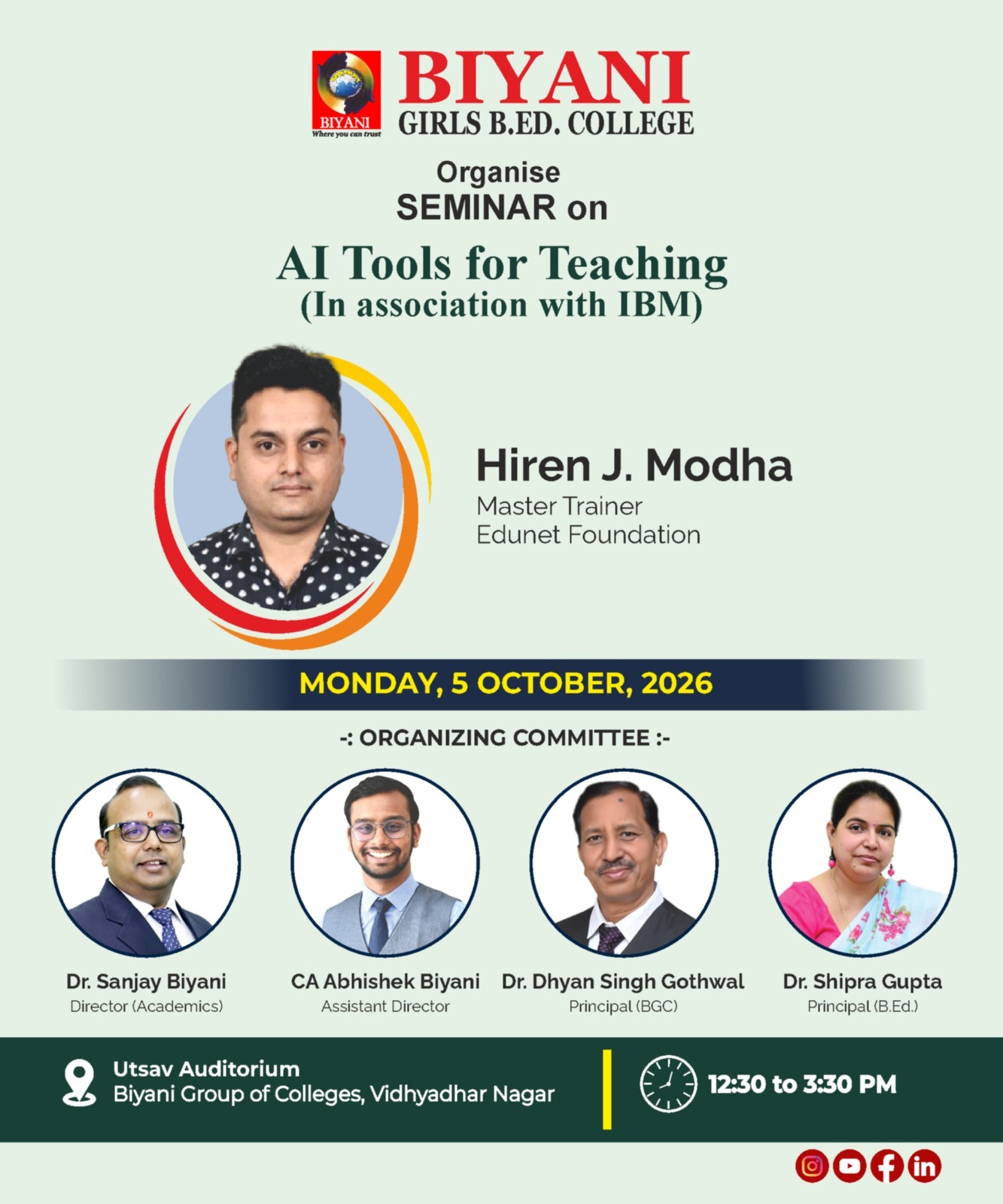
Education in the 21st century has moved far beyond chalkboards and memorization. With rapid technological growth, evolving learner expectations, and global challenges, classrooms are transforming into dynamic learning spaces. Modern students need more than academic knowledge—they must develop critical thinking, creativity, collaboration, and digital skills. To nurture these essential teaching competencies, choosing the right teacher training institute is crucial. If you are looking for the best B.Ed college in Jaipur, then opt the B.Ed course offer by Biyani Girls College.Here you get quality education, innovative teaching practices, and a future-ready learning environment.
Student-Centered Learning
Student-centered learning focuses on active participation rather than passive listening. In this approach, teachers act as facilitators who guide students in exploring ideas, asking questions, and building their own understanding. Activities such as group discussions, debates, role plays, and peer teaching encourage confidence,
communication skills, and independent thinking.
Activity-Based and Experiential Learning
The principle of “learning by doing” lies at the heart of modern education.Activity-based and experiential learning engage students through hands-on experiences, projects, experiments, and real-life problem-solving. Field visits, science experiments,simulations, and surveys help learners connect theory with practice, making learning more
meaningful and long-lasting.
Integration of Technology and Digital Tools
Technology has become a powerful tool in today’s classrooms. The use of smart boards, multimedia presentations, educational apps, online quizzes, and virtual learning platforms makes lessons more interactive and engaging.
Digital resources such as videos, animations, podcasts, and simulations simplify complex concepts and support personalized learning based on individual pace and ability.
Blended Learning Approach
Blended learning combines traditional classroom teaching with online learning methods.Students can access recorded lectures, e-books, and digital assessments outside the classroom, while face-to-face time is used for discussions, collaborative tasks, and problem-solving. This approach promotes flexibility, self-discipline, and effective use of classroom time.
Project-Based Learning (PBL)
Project-Based Learning allows students to gain knowledge by working on real-world projects over an extended period. These projects often involve research, teamwork, planning, and presentations. PBL develops problem-solving abilities, creativity, collaboration, and practical skills, preparing learners for real-life challenges beyond the classroom.
Collaborative and Cooperative Learning
Collaboration is a vital skill in the modern world. Cooperative learning encourages students to work in pairs or groups to achieve shared goals. Group assignments, peer reviews, and team projects promote mutual learning, respect for diverse viewpoints, and social development, while also ensuring active participation from all learners.
Inquiry-Based and Problem-Based Learning
Inquiry-based learning emphasizes curiosity and exploration by encouraging students to ask questions and investigate solutions. Problem-based learning presents real-life situations that require analysis, research, and logical reasoning. These methods help students develop critical thinking skills and lifelong learning habits.
Inclusive and Differentiated Teaching
Modern classrooms are diverse, with learners having different abilities, backgrounds, and learning styles. Differentiated instruction adapts teaching methods, content, and assessments to meet individual needs. Inclusive teaching strategies ensure equal learning opportunities for all students, including those with special educational needs.
Conclusion
Innovative teaching methods form the foundation of effective 21st-century education. They shift the focus from rote memorization to the development of essential life skills such as critical thinking, creativity, collaboration, and digital competence.By embracing student-centered, technology-integrated, and experiential approaches, teachers can create engaging, inclusive, and future-ready classrooms. Ultimately, innovative teaching prepares students to become confident, responsible, and capable citizens in a rapidly changing world.
Blog By:
Ms.Vinita Sharma
Assistant Professor, Department Of Education
Biyani Girls B.Ed College,Jaipur